
Friday, May 15, 2026
Home Blog Page 11

How to Stay Safe During a Nuclear Emergency: A Complete Preparedness Guide

0
Peace of mind through preparedness: Nuclear safety starts with you.

In today’s world, emergency preparedness is more important than ever. While nuclear emergencies are rare, knowing how to respond calmly and safely is a smart step for every family and community. This article provides practical, non-alarming tips to help you understand what to do during such events, how to stay safe indoors, and how to support recovery efforts.


🔍 What Is a Nuclear Emergency?

A nuclear emergency can involve the accidental release of radiation from a power plant, a transportation incident, or other industrial sources. These situations are uncommon, but public awareness helps reduce confusion and improve safety outcomes when preparedness is prioritized.


🧭 Steps to Take During a Nuclear Emergency

1. Get Inside Quickly
In case of a radiation alert, your first step should be to seek indoor shelter. A basement or interior room with no windows offers the best protection. Close all doors and windows to limit outside air from entering.

2. Stay Informed
Use a battery-powered radio or official government alert app to follow real-time updates. Authorities will provide instructions on when it is safe to leave your shelter or take protective actions.

3. Emergency Supplies Checklist
Prepare a basic kit in advance that includes:

  • Bottled water (at least 3-day supply per person)
  • Non-perishable food
  • Flashlight and extra batteries
  • First aid kit
  • Face masks and plastic sheeting
  • Personal hygiene items
  • Important documents in waterproof storage

4. Limit Outdoor Exposure
Avoid going outside during the first 24–48 hours unless advised. Radiation levels drop significantly in this period, and your shelter provides important protection.


🌱 After the Emergency

Once the all-clear is given, follow safety instructions for clean-up and decontamination:

  • Change clothes and take a shower if possible.
  • Dispose of clothing exposed to dust or particles.
  • Sanitize surfaces and avoid touching unfamiliar debris.

Support local recovery by helping others and staying connected with official services.


🧠 Mental Health and Community Support

Emergencies can be stressful. Staying connected with family, friends, and community support groups helps reduce anxiety and promotes faster recovery. Share only verified information to prevent panic or confusion.


✅ Final Thoughts

Preparedness is not about fear—it’s about confidence. By learning what to do before, during, and after a nuclear emergency, you empower yourself and others to respond with calm and care. Government agencies regularly provide training and resources to support community safety. Stay informed, stay prepared, and share this knowledge to build a safer tomorrow.

Latest Breakthroughs in Diabetes Treatment (2025 Update)

0
Diabetes Treatment

Managing Diabetes Treatment is evolving rapidly with exciting new therapies and technological advancements. Whether you’re living with type 1 or type 2 diabetes, 2025 brings fresh hope through innovations that enhance convenience, safety, and long-term control. Here’s a detailed look at the most recent, science-backed developments in diabetes care.

🧪 Type 2 Diabetes: Game-Changing Treatments

💊 1. Orforglipron: A Pill-Based Alternative to Ozempic

Orforglipron is a new once-daily oral GLP-1 receptor agonist developed by Eli Lilly. It works similarly to popular injectables like Ozempic but is taken as a pill — no injections needed.

Key Benefits:

  • Helps reduce HbA1c levels by up to 1.5%
  • Supports significant weight loss
  • Easy to take without food or water restrictions

This new format may help more patients stick with their treatment plans long-term.


🩸 2. Awiqli (Insulin Icodec): Weekly Insulin Dosing

Novo Nordisk’s Awiqli is a once-weekly basal insulin, ideal for people with type 2 diabetes who need consistent insulin support. With fewer injections, it improves quality of life while maintaining strong blood sugar control.


💉 3. Smart Semaglutide Pens by Zydus

Zydus Lifesciences is developing a multi-dose semaglutide pen that allows adjustable dosing. This flexibility can help doctors personalize treatment, making diabetes management more effective and patient-friendly.


🥦 4. Low-Carb Diet + App Support = Remission

A study from La Trobe University in Australia found that a low-carb diet supported by the Defeat Diabetes app helped:

  • 41% of participants maintain normal HbA1c without medication
  • Nearly 20% achieve full remission

This shows how digital health tools can be powerful allies in reversing type 2 diabetes naturally.


🔬 Type 1 Diabetes: Major Scientific Advances

🧫 1. Lantidra (Donislecel): Islet Cell Therapy

Lantidra is a cell-based therapy that uses donor islet cells to restore insulin production in people with type 1 diabetes. It’s ideal for patients experiencing severe hypoglycaemia despite intensive insulin therapy.

How It Works:

  • Islet cells are infused into the liver
  • They start producing insulin naturally
  • Some patients may become insulin-independent

🤖 2. Omnipod 5: Tubeless Insulin Pump

The Omnipod 5 is a tubeless, automated insulin delivery system now expanding into global markets. It pairs with a continuous glucose monitor (CGM) and adjusts insulin levels in real time, offering more freedom and better control.


🌱 3. Hope for a Cure: Beta Cell Regeneration

New studies are exploring how to regenerate insulin-producing beta cells and retrain the immune system to stop attacking them. These therapies could one day offer a functional cure for type 1 diabetes.


🌍 Emerging Topics in Diabetes Care

🔍 ADA 2025 Guidelines: What’s New?

  • Early combination therapies are now recommended for better long-term control
  • New protocols for managing diabetic ketoacidosis (DKA) and hyperosmolar states
  • Updated GLP-1 use during surgery and hospital stays

⚠️ A New Type: Type 5 Diabetes

The International Diabetes Federation has recognised Type 5 Diabetes, linked to malnutrition and undernutrition, especially in low-income countries. New diagnostic criteria and treatments are under development to address this unique form.


📌 Final Thoughts

The future of diabetes care is focused on simplicity, precision, and empowerment. From weekly insulin and oral GLP-1 pills to potential cures through cell therapy, patients now have more tools than ever to live healthier lives.

North Korea Warns US Golden Dome Missile Defense Is Dangerous

3
North Korea
Global Tensions Rise Over Space Weapon Plan

North Korea Says US ‘Golden Dome’ Missile Defense Is a Dangerous Plan

North Korea has spoken out against a new US missile defense project called the Golden Dome. This system is designed to protect the United States from missile attacks by using satellites in space. North Korea says the plan is very dangerous and could lead to serious global problems, including the threat of nuclear war.

What Is the Golden Dome?

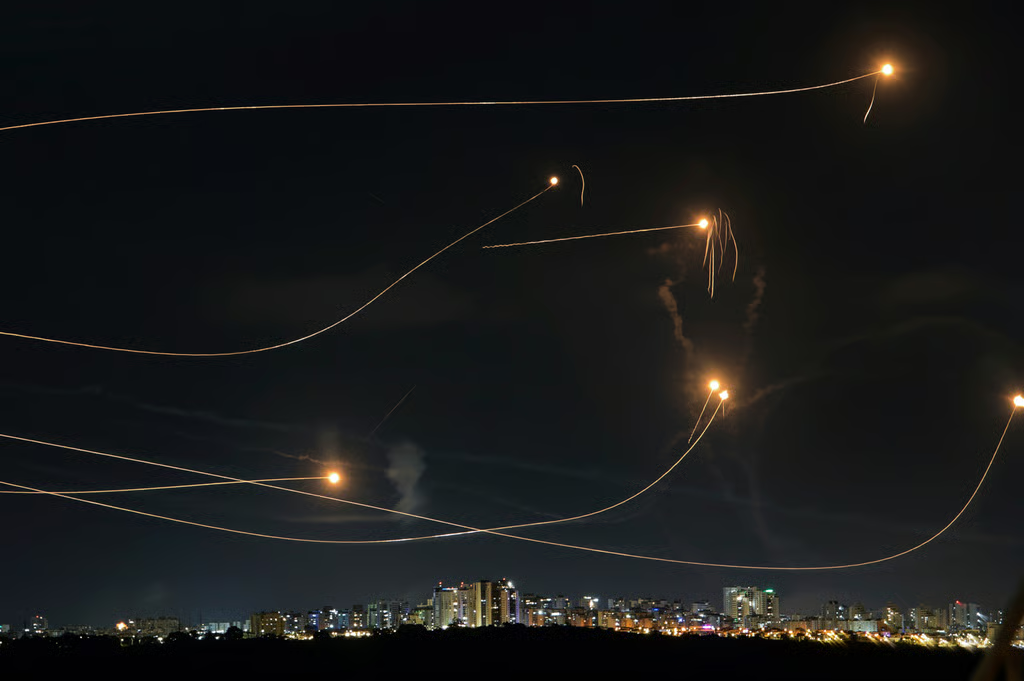
The Golden Dome is a large-scale missile defense program announced by the United States. It aims to use hundreds of satellites in space to detect and destroy enemy missiles before they reach American land. The idea is similar to Israel’s Iron Dome, but this version would operate in space and cover a much larger area.

The project is expected to cost over $175 billion. It will involve major defense companies and new technology to build a strong defence system in space. The US government says this system will help protect the country from threats by North Korea, Iran, Russia, and China.

Why Is North Korea Opposed?

North Korea believes the Golden Dome is a sign that the US wants to control outer space. They said the plan could cause a new arms race, where countries start building more and more weapons to compete. According to North Korea, this increases the chances of war, especially a nuclear one.

China and Russia Also Respond

North Korea is not alone. Both China and Russia have also criticised the Golden Dome plan. China warned that turning space into a war zone is a big mistake. Russia said the project could break peace agreements and cause global tension. These countries are concerned the US is trying to gain power in space at the cost of peace.

Is the Plan Safe or Risky?

Experts are divided. Some believe it’s important to protect the country with modern technology. Others say it’s a risky and expensive plan that may not even work. There are fears it could lead to more weapons being developed around the world, making things more dangerous for everyone.

Final Thoughts

The Golden Dome is one of the biggest defence projects in US history. While it may offer protection, many countries believe it could bring more danger than safety. As the project moves ahead, the world is watching closely to see how it affects peace and security.

Nitin Gadkari: The Visionary Leader Driving India’s New Road Revolution

0

Celebrate the birthday of Shri Nitin Gadkari, India’s Road Transport Minister, and explore his major contributions in transforming the nation’s highway infrastructure.

🎉 Happy Birthday, Shri Nitin Gadkari – The Man Behind India’s Road Infrastructure Transformation 🎉

On the special occasion of Shri Nitin Gadkari’s birthday, we honour a leader whose vision and action have reshaped India’s transport landscape. Known as the “Highway Man of India”, he has spearheaded some of the most ambitious infrastructure projects in Indian history.


🇮🇳 A Leader with a Vision for Connectivity

Since taking charge as the Union Minister for Road Transport and Highways, Nitin Gadkari has brought about a sea change in India’s approach to infrastructure development. His tenure is marked by innovation, speed, and sustainability in road construction.

In 2014, India was building highways at around 12 km per day. Under Gadkari’s leadership, that figure peaked at 37 km per day by 2021 — a feat that placed India among the fastest-growing nations in road infrastructure.


🚧 Key Projects That Changed the Game

1. Bharatmala Pariyojana

A long-term infrastructure plan to improve road connectivity across India. This project aims to develop over 83,000 km of highways by 2025, boosting trade routes, border access, and economic corridors.

2. Delhi–Mumbai Expressway

One of India’s longest expressways, this 1,386 km stretch is drastically cutting travel time between Delhi and Mumbai. It supports faster freight movement and reduces fuel consumption, positively impacting the environment and economy.

3. Green and Sustainable Construction

Gadkari has championed the use of eco-friendly materials like waste plastic and fly ash in road construction. His push for electric vehicles (EVs) and biofuels is also aligned with India’s green energy goals.

4. Digital Efficiency & Gati Shakti

The launch of the ‘Gati Shakti’ platform ensures coordinated infrastructure development among multiple ministries, avoiding delays and enhancing transparency.


🌱 A Sustainable and Inclusive Approach

Gadkari’s initiatives are not just about highways; they are about inclusive growth, enabling better access to education, healthcare, and economic opportunities in rural and remote areas. His policies promote:

  • Reduced travel time and fuel usage
  • Safer roads with better engineering
  • Employment generation through massive infrastructure projects
  • Clean energy adoption in transport

🛣 Impact on the Nation

India now boasts the second-largest road network in the world, thanks in part to Gadkari’s leadership. His ability to fast-track approvals, attract private investments, and manage public resources effectively has turned stalled projects into success stories.


🙏 Honoring a Leader of the People

On this birthday, we extend our warm wishes to Shri Nitin Gadkari and thank him for his service and dedication.

🎂 Happy Birthday, Nitin Gadkari ji!
May you continue to guide India’s growth journey with strength, vision, and integrity.

As tensions between India and Pakistan escalate, the IPL 2025 has been suspended indefinitely.

0
IPL 2025

The ongoing edition had been clouded by uncertainty since the Punjab Kings vs Delhi Capitals game in Dharamsala was cancelled halfway through due to air raid alerts.

IPL 2025 suspended amid India-Pakistan conflict, cricket stadium under security alert

The growing military confrontation between India and Pakistan has resulted in an indefinite suspension of the Indian Premier League (IPL). It would be wrong to continue the event at such a crucial moment, according to a top BCCI official. After the Punjab Kings vs. Delhi Capitals game in Dharamsala was called off in the middle of Thursday due to air raid alerts in neighbouring places like Jammu and Pathankot, worries over the tournament’s survival increased. The source clarified, “It doesn’t feel right to continue with cricket when the nation is dealing with a serious conflict.” Originally, the IPL season was supposed to end in Kolkata on May 25.

With plans to continue the remaining matches only until the situation between India and Pakistan stabilises, the Indian Premier League (IPL) has been postponed indefinitely. Reports state that four playoff games and twelve league games remain to be played.

The move follows India’s recent missile strikes against terror sites in Pakistan and Pakistan-Occupied Jammu and Kashmir, which were initiated almost two weeks after the devastating attack in Pahalgam on April 22 that killed 26 people.

Following air raid warnings and loud explosions reported close to Jammu, numerous areas of Punjab, including Pathankot, Amritsar, Jalandhar, Hoshiarpur, and Mohali, as well as the Union Territory of Chandigarh, witnessed blackouts on Thursday night.

Due to reports of Indian drone activities in places like Lahore and Rawalpindi, the Pakistan Super League (PSL) has been moved to the United Arab Emirates.

Many international players are naturally concerned about the intensifying tension, according to sources close to the IPL. The ten IPL teams signed sixty-two foreign players at last year’s mega-auction, and several of them are scheduled to return home shortly.

A franchise official responded, “Everyone is safe, but naturally, the players are concerned after witnessing these developments,” in response to a question concerning the welfare of players from other countries.

Following the disruption of their match in Dharamsala, players from the Delhi Capitals and Punjab Kings are currently on their way to Delhi via road.

The Lucknow Super Giants (LSG) and Royal Challengers Bengaluru game that was supposed to take place in Lucknow on Friday has also been cancelled. Not long after the league’s suspension was declared, LSG shared the message “Nation First” on its official social media account.

Cricket Australia, which has been keeping a close eye on the unrest, acknowledged the issue and reaffirmed its support for the players’ safety in the area. The players’ union of New Zealand also voiced worries about the security threats facing its players in Pakistan and India.

Tensions Between India and Pakistan Lead to Closure of 24 Airports; Airlines Issue Travel Warnings

0
Enhanced security measures at Indian airports following rising tensions with Pakistan, including secondary checks and pre-boarding inspections.
Airports across India implement heightened security protocols, including secondary checks and ID verifications, amid escalating tensions with Pakistan.

The Civil Aviation Ministry has announced the temporary closure of 24 airports across the country, effective Thursday evening, due to rising tensions between India and Pakistan. This follows an escalation in hostilities, including a Pakistani drone and missile strike targeting Indian cities in Jammu, Punjab, Gujarat, and Rajasthan.

In light of the heightened security concerns, multiple Indian airlines have issued travel advisories, advising passengers to stay informed and cooperate with increased security measures at the airports.

Also read Rajnath Singh Meets CDS and Service Chiefs After Pakistan’s Provocation at Border

The Ministry of Civil Aviation has not disclosed the duration of the airport closures or the specific reasons behind the decision. However, these closures are part of a broader security protocol, with many of the affected airports located near international borders or in areas of strategic importance.

The temporary suspension of civil flights is expected to disrupt travel across northern and western India, and passengers are advised to verify their flight details with airlines before heading to the airport.

In response to the heightened threat, the Bureau of Civil Aviation Security (BCAS) has instructed airlines and airports across India to implement enhanced security measures. These include a Secondary Ladder Point Check (SLPC), commonly known as pre-boarding inspections, at all terminals.

Additionally, airport vehicles will undergo thorough screening, ID checks will be enforced, and random luggage checks will be carried out. Access to terminal buildings for visitors has been restricted, and Air Marshals will be deployed as necessary.

The BCAS issued the following directive:
“In light of the recent Pahalgam attack and the overall surge in security concerns, it is essential to increase security across all civil aviation facilities—airports, airstrips, airfields, air force stations, helipads, and aviation-related institutions—to prevent any untoward incidents. All stakeholders must exercise maximum caution.”

Air India has issued the following notice:
“Due to BCAS orders regarding enhanced security measures, passengers are advised to arrive early for check-in and boarding. Check-in will close 75 minutes before departure.”

Similarly, Akasa Air stated:
“Given the heightened security at all airports, we recommend passengers arrive at least three hours prior to their departure to ensure a smooth check-in process.”

IndiGo, India’s largest airline, issued a statement advising:
“Due to the current security climate, heightened measures are in place at all airports. Passengers should plan for extra time to account for security checks. We appreciate your cooperation.”

With the geopolitical situation remaining tense, aviation officials and airline personnel are working closely with national security agencies to maintain smooth operations while ensuring the safety of all passengers.

In addition to the airport disruptions, several states have also closed schools, enforced blackouts in border districts, and suspended leave for police officers and administrators.

Foreign Secretary Vikram Misri addressed the situation, stating, “Pakistan escalated the situation, and our response was a direct reaction. The choice lies with Pakistan. Our goal is not escalation but rather responding to the terrorist attack in Pahalgam on April 22.”

Rajnath Singh Meets CDS and Service Chiefs After Pakistan’s Provocation at Border

0
Enhanced security measures at Indian airports following rising tensions with Pakistan, including secondary checks and pre-boarding inspections.
Airports across India implement heightened security protocols, including secondary checks and ID verifications, amid escalating tensions with Pakistan.

In a major escalation, Pakistan targeted military stations in Jammu, Pathankot, and Udhampur late last night. The Indian Army responded with a swift and strong retaliation

Rajnath Singh
Sources report that multiple Pakistani military posts along the Line of Control (LoC) were destroyed in the Indian Army’s retaliatory strikes.

Defence Minister Rajnath Singh held urgent talks with India’s top military leadership after Pakistan launched coordinated aerial attacks on multiple Indian military locations. The Indian Army responded with targeted counterstrikes along the Line of Control.

Full Report:
Defence Minister Rajnath Singh met with Chief of Defence Staff General Anil Chauhan and the Army, Navy, and Air Force chiefs on Friday morning in Delhi following a dramatic escalation along the western border.

The meeting came just hours after India repelled a second wave of drone and missile strikes launched by Pakistan, targeting both military bases and civilian cities in Rajasthan, Gujarat, Punjab, and Jammu & Kashmir.

According to officials, the attacks began around 8:30 PM on Thursday night, with key military stations in Jammu, Pathankot, and Udhampur coming under fire. The Indian Army responded instantly, activating high-alert protocols and countering the aerial threat.

Retaliation Across LoC
In a strong response, the Indian military launched Operation Sindoor, delivering targeted strikes on Pakistani military positions along the Line of Control (LoC). Sources confirmed that anti-tank guided missiles were used to dismantle enemy bunkers and launchpads.

“Several forward Pakistani military installations were neutralized as part of India’s precision response,” a defence source said.

Widespread power outages were also reported in Srinagar, parts of Jammu, and several regions in Punjab and Rajasthan during the conflict.

Army’s Statement:
The Indian Army confirmed that Pakistan carried out multiple ceasefire violations and deployed drone-based attacks across various sectors.

“On the night of May 8–9, 2025, Pakistani forces initiated aerial assaults and ceasefire breaches along the LoC. The Indian response was immediate and proportional, compelling enemy forces to retreat,” said the official statement.

The Indian Army remains firmly committed to safeguarding the nation’s sovereignty and borders. It has reiterated that any aggressive actions or threats against India will be met with a robust and decisive response.

Following India’s decision to suspend the Indus Water Treaty in the wake of the April 22 Pahalgam terror attack, Pakistan engaged in continued, unprovoked firing along the Line of Control. In retaliation, India launched a highly coordinated strike, firing 24 missiles in just 25 minutes, targeting nine locations in Pakistan and Pakistan-Occupied Kashmir (PoK). The attack resulted in the deaths of 70 terrorists and left 60 others injured. According to government sources, the operation was meticulously planned to inflict maximum damage while minimizing detection, extending beyond typical military retaliation.

In response, Pakistan fired indiscriminately across the Line of Control, leading to the tragic loss of at least 16 civilian lives in Jammu and Kashmir. The Indian Army is actively countering these actions with forceful measures to neutralize further threats.

Adel Al-Jubeir’s Diplomatic Visit to India: Key Insights

0
Adel Al-Jubeir
Adel Al-Jubeir
Adel Al-Jubeir

Showing swift diplomatic action, Adel Al-Jubeir, Saudi Arabia’s Minister of State for Foreign Affairs, arrived in New Delhi last night (May 7, 2025). His arrival happened at the same time as the arrival of Seyed Abbas Araghchi, the Iranian Foreign Minister. Araghchi is in New Delhi for a short visit after India attacked terrorist locations inside Pakistan on Wednesday (May 7).

Sindoor Operation will have new information available on May 8, 2025.

External Affairs Minister S. Jaishankar said he had a positive meeting this morning with Adel Al-Jubeir, the Saudi Arabian Minister of State for Foreign Affairs. Jaishankar shared India’s views on strongly fighting terrorism. Sources say Al-Jubeir’s visit was not announced beforehand and happened because of the increased tension between India and Pakistan.

Adel Al-Jubeir, Saudi Arabia’s Minister of State for Foreign Affairs, arrived in New Delhi last night (May 7, 2025), showing swift diplomacy. His arrival was at the same time as Iranian Foreign Minister Seyed Abbas Araghchi, who is in New Delhi for a one-day visit after India attacked terrorist locations inside Pakistan on Wednesday (May 7).

Operation Sindoor updates on May 8, 2025

External Affairs Minister S. Jaishankar said he had a positive meeting this morning with Adel Al-Jubeir, the Saudi Arabian Minister of State for Foreign Affairs. Jaishankar shared India’s views on strongly fighting terrorism. Sources say Al-Jubeir’s visit was not announced beforehand and happened because of the increased tension between India and Pakistan.

Today, May 8th, he’s scheduled to meet with his Iranian colleague at 12:30 p.m. Mr. Araghchi visited Pakistan for a day on Monday, May 5th. He wants Islamabad and New Delhi to talk and reduce tensions after the terrible terror attack in Pahalgam on April 22nd, where 26 people died and many were hurt.

India shared its investigation results regarding the Pahalgam attack with several foreign ambassadors, including Saudi Arabia’s. After India promised to take action after the Pahalgam terror incident, Pakistan’s Foreign Minister Ishaq Dar also talked with Saudi Foreign Minister Prince Faisal Bin Farhan.

Putin Tells PM Modi: Perpetrators of Terror Attack Must Be Brought to Justice, Reaffirms Russia’s Support for India

1
FILE -Russian President Vladimir Putin, right, and Indian Prime Minister Narendra Modi pose for a photo shaking hands prior to their talks on the sidelines of the Shanghai Cooperation Organisation (SCO) summit in Samarkand, Uzbekistan, Sept. 16, 2022. The Kremlin on Thursday said Modi will visit Russia on July 8-9 and hold talks with Putin. The visit was first announced by the Russian officials last month, but the dates have not been previously disclosed. (Alexandr Demyanchuk, Sputnik, Kremlin Pool Photo via AP, File)

During the continuing events following the Pahalgam attack on April 22, Defence Secretary Rajesh Kumar Singh met with Prime Minister Narendra Modi. The Prime Minister was briefed on the operational readiness of the armed forces by the Chief of the Air Staff, Air Chief Marshal AP Singh, and the Navy Chief, Admiral Dinesh K. Tripathi, prior to the meeting.

Terror Attack
Russia’s President Vladimir Putin Backs India’s Anti-Terrorism Efforts in Key Discussion with Prime Minister Narendra Modi

The truce was broken by the Pakistani army on Monday in a number of areas across the international border and the Line of Control (LoC) in Jammu. Pakistani troops were accused in an Indian army statement of using unwarranted small weapons fire in these areas. It further stated, “The Indian Army reacted in a timely and appropriate manner.”

Pahalgam terror attack: Key updates

  • According to the news agency AP, Iran’s foreign minister, Abbas Araghchi, travelled to Pakistan on Monday in an attempt to ease tensions between the two nations following the Pahalgam terror assault.
  • Araghchi will meet with Prime Minister Shehbaz Sharif, President Asif Ali Zardari, and his counterpart from Pakistan, Ishaq Dar. Additional information was not provided by Pakistan’s foreign ministry. “Pakistan is presenting its case to friendly countries,” Attaullah Tarar, the minister of information, told reporters.

Putin Tells PM Modi: Perpetrators of Terror Attack Must Be Brought to Justice, Reaffirms Russia’s Support for India

  • In addition, Pakistan, a non-permanent member, asked the United Nations Security Council (UNSC) to have “closed consultations” on Monday to examine the rising tensions with India following the Pahalgam terror assault. Greece, which will chair the UNSC in May, hailed the talks as a chance to ease tensions between the two nations. According to the custom of rotating leadership, Islamabad will lead the council in July.
  • According to the Dawn, Pakistan’s federal government and military informed all political parties on the status of bilateral relations with India on Sunday. The Pakistan Tehreek-i-Insaf party, led by imprisoned former prime minister Imran Khan, also participated digitally in the briefing.
  • The article claims that every major party pledged a strong defence in the event that India engaged in any “misadventure”.
  • Speaking at an event, Defence Minister Rajnath Singh also promised a response. It is my duty as defence minister to make sure that my troops and the nation’s borders are secure. It is my duty to respond appropriately to anybody who would dare to attack our nation,” he declared.
  • The Centre also went ahead and suspended the Indus Waters Treaty, one of its retaliatory actions. According to HT, India has implemented its decisions to prevent a “single drop” of water from the Indus rivers from reaching Pakistan by cutting off water flow from the Baglihar dam on the Chenab river and planning to reduce runoffs from the Kishanganga project on the Jhelum.