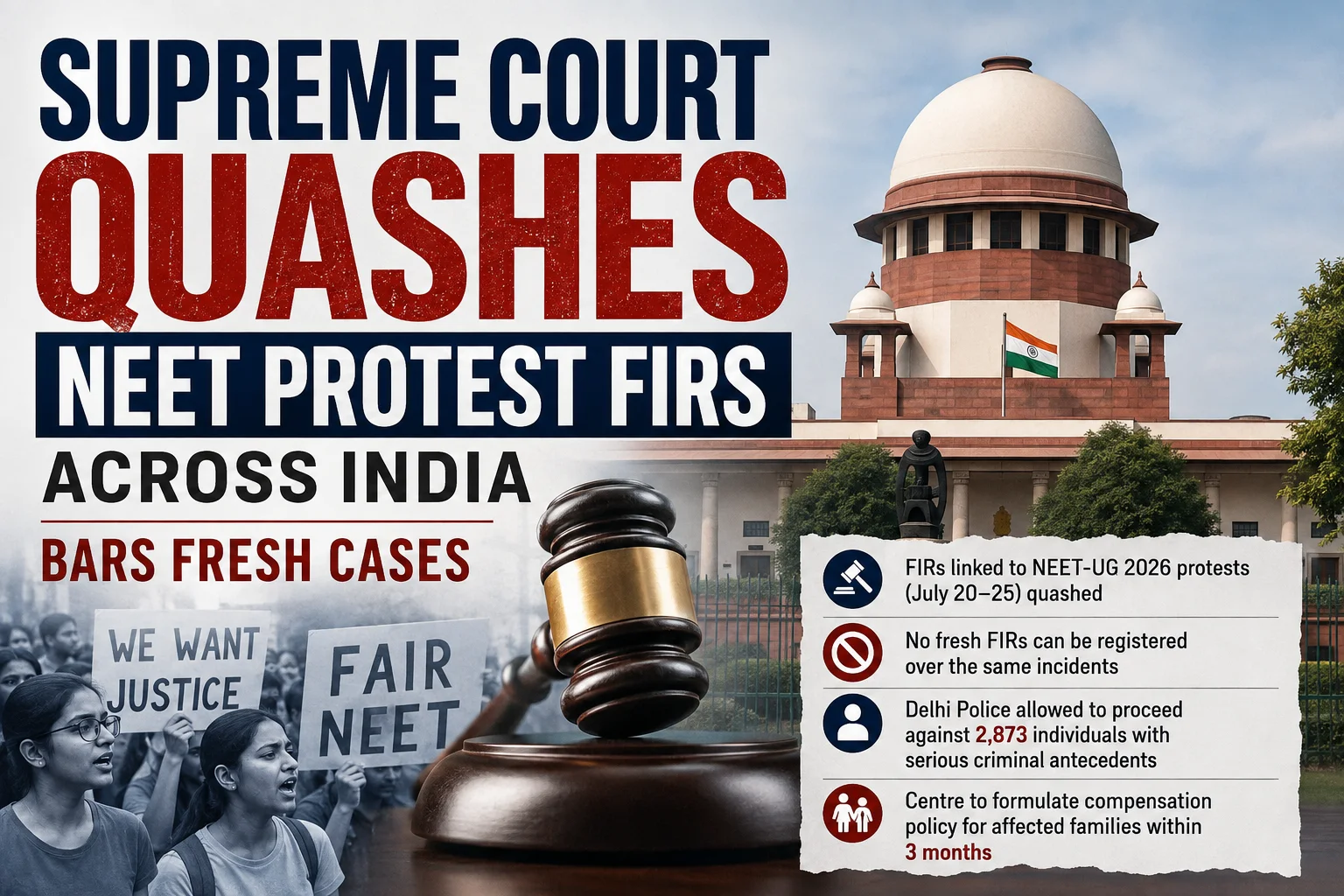
Supreme Court Quashes NEET Protest FIRs Across India, Bars Fresh Cases
New Delhi: The Supreme Court has ordered the closure of FIRs registered in connection with student protests over the NEET-UG 2026 issue, giving major relief to young protesters across the country.A bench headed by Chief Justice of India Surya Kant, along with Justices Joymalya Bagchi and V. Mohana, invoked its extraordinary powers under Article 142 of the Constitution while passing the order on September 1.
The court said its decision was aimed at protecting the future prospects of students and young people who had participated in the protests bona fide. FIRs connected with the protests held between July 20 and July 25, 2026, have been ordered not to be pursued or investigated.
Supreme Court Extends Relief Across India
The applications before the Supreme Court included pleas from the Centre, through the Delhi Police, as well as the governments of Maharashtra, Bihar, West Bengal, and Assam.While these authorities had approached the court regarding FIRs registered in their respective jurisdictions, the Supreme Court extended the effect of its order across the country.
The court directed that any other FIR connected with the same protest incidents between July 20 and July 25, even if it had not been brought before the bench, should not be pursued or investigated and should be treated as closed.
The court also made it clear that no fresh FIR can be registered by any state or Union Territory in relation to the same protest incidents.
Article 142 Used to Protect Students' Future
The Supreme Court relied on Article 142, which gives the apex court the power to pass orders necessary to ensure complete justice in matters before it.The bench said the circumstances of the case justified the use of this extraordinary constitutional power, particularly considering the future of young protesters who had participated in the demonstrations.
The court also clarified that the decision was based on the peculiar facts and circumstances of the case and should not be treated as a precedent.
Relief Does Not Cover 2,873 Individuals
The Supreme Court has, however, allowed an important exception.The Delhi Police has been permitted to register a fresh FIR concerning 2,873 individuals who were reportedly present at the Jantar Mantar protest and were described by authorities as having serious criminal antecedents.
The proposed investigation is not intended to target people merely because they participated in the protest. According to the government's submissions, it would focus on allegations involving bodily harm or destruction of property during the demonstrations.
The court also made clear that the individuals concerned would retain their legal rights and remedies.
Center Asked to Formulate Compensation Policy
The Supreme Court's order also addressed the issue of students who died by suicide in connection with the NEET-UG 2026 controversy.The Centre informed the court that it would formulate a pan-India policy for compensation for eligible families. The court directed the Centre to work out the policy within three months and circulate it to the states and Union Territories.
Compensation is to be provided to eligible families after the policy is formulated.
September 5 Protest Called Off
The Supreme Court's intervention has also brought a planned protest in Delhi to an end.Saurav Das, co-convener of the Cockroach Janata Party, informed the court that the organisation had withdrawn its proposed September 5 protest march following the government's assurances and the Supreme Court's order.
The planned demonstration had been announced amid demands for the withdrawal of cases against protesters and action on other issues connected with the NEET-UG controversy.
What the Supreme Court Order Means
The September 1 decision provides broad relief to students who participated in the July protests.The key directions are
FIRs connected with the July 20–25 protests are not to be pursued or investigated. Such FIRs are to be treated as closed. States and Union Territories cannot register fresh FIRs over the same incidents. The Delhi Police can proceed with a specific case concerning 2,873 individuals, subject to the court's directions. The Centre must formulate a nationwide compensation framework within three months. The September 5 protest announced by the student group has been withdrawn.
The Supreme Court's decision effectively draws a line under the criminal cases arising from the specified protests while leaving the authorities free to pursue allegations of serious violence or property destruction involving the individuals covered by the exception.
A Significant Relief for Student Protesters
The ruling is significant because an FIR can have consequences for students long after a protest has ended, including potential effects on their education and future employment opportunities.By invoking Article 142, the Supreme Court has sought to ensure that students who participated in the protests do not face continuing criminal proceedings simply because they took part in the demonstrations.
At the same time, the court has preserved the government's ability to investigate specific allegations of serious criminal conduct, maintaining a distinction between participation in a protest and involvement in violence or destruction of property.
The court has also encouraged both sides to continue resolving the remaining issues through dialogue and cooperation.


