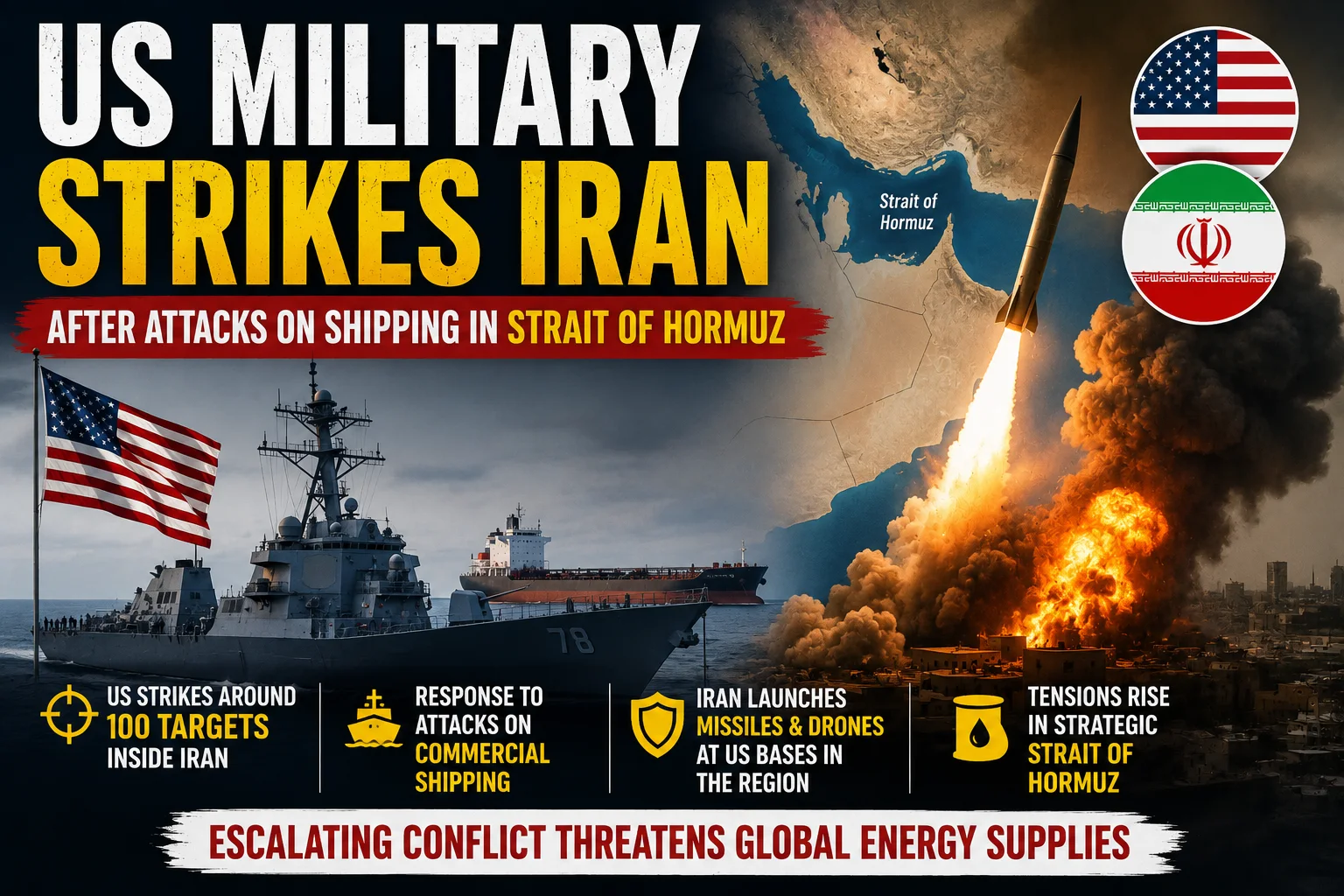
US Military Strikes Iran After Attacks on Shipping in Strait of Hormuz
Washington: The United States has launched fresh military strikes against targets inside Iran after what Washington described as attempted attacks by Iranian forces on commercial shipping in the strategically important Strait of Hormuz and on American service members in the region.The latest strikes mark a major escalation in the confrontation between the United States and Iran, coming after a period of relative calm between the two sides.
The US Central Command (CENTCOM) said American forces began striking targets belonging to Iran's Islamic Revolutionary Guard Corps (IRGC). The targets included air defense systems, communications facilities, and capabilities associated with laying sea mines and threatening maritime traffic.
US Says Strikes Were Response to Shipping Threats
According to the US military, the operation followed recent attempted attacks by the IRGC against commercial vessels travelling through the Strait of Hormuz.The waterway is one of the world's most important energy routes, carrying a substantial share of global oil shipments. Any prolonged disruption in the strait could have consequences for international energy markets and shipping.
US officials said the military action was also linked to attacks or attempted attacks against American personnel deployed in the Middle East.
The Washington Post reported that the latest strikes followed an earlier US operation against Iranian rocket launchers on Larak Island that American officials said were preparing to disperse sea mines into the strait.
Trump Warns Iran of Stronger Response
US President Donald Trump warned Iran that Washington would respond with greater force if Tehran retaliated against the latest strikes.Trump said the United States was carrying out what he described as large-scale strikes against Iranian targets near the Strait of Hormuz. He also said Washington had responded to what he described as Iran's attempt to place sea mines in the waterway and its missile attack on a US military base in Jordan.
The US said missiles fired towards the Jordanian base were intercepted.
Trump's warning has raised concerns that the latest exchange could develop into a wider regional confrontation if Iran continues its military response.
Iran Responds With Missiles and Drones
Iran has rejected the US action and launched its own military response.Iranian forces claimed attacks against US military positions in the region, while reports indicated missile and drone activity involving American facilities in Jordan, Bahrain, and Kuwait.
Kuwait also reported that its air defences responded to hostile drones, while Iranian military statements claimed attacks against US forces in the region.
Iran's Islamic Revolutionary Guard Corps said the American strikes would further tighten restrictions around the Strait of Hormuz.
The exchange has increased fears that the strategically vital waterway could become the center of a much wider military confrontation.
Tanker Attacks Raise Shipping Concerns
The military escalation comes after attacks involving commercial tankers in and around the Strait of Hormuz.Two tankers carrying Saudi crude oil were reportedly attacked by unidentified projectiles while travelling through the region. No casualties were reported, but the incidents have heightened concerns about the safety of commercial shipping.
The United States has said its military presence in the region is intended partly to protect maritime traffic and prevent Iran from using mines, missiles, and other weapons to disrupt shipping.
US officials have also said American forces intercepted missiles and drones directed towards vessels operating in the area during the latest escalation.
US Strikes Around 100 Targets
US officials said the latest operation struck a broad range of Iranian military and maritime-related targets.According to US officials cited by Axios, around 100 targets were attacked during Tuesday's operation. These included IRGC air-defense systems, radar installations, mine-laying capabilities, communications sites, anti-ship missile launchers, and attack-drone launchers.
The operation also reportedly included strikes on two Iranian government tankers, marking a new development in the US campaign.
American officials said the objective was to reduce Iran's ability to threaten commercial vessels, US Navy ships, and aircraft operating around the Strait of Hormuz.
Iran Reports Civilian Casualties
Iranian authorities have also reported civilian casualties following the US strikes.Iranian state media reported that a US missile strike in Khuzestan province killed seven people and injured eight others. Iranian media also reported strikes near Ahvaz and Aghajari.
Iranian officials further alleged that a US strike hit a home hosting a wedding ceremony in southern Iran, causing civilian deaths and injuries. The US military said it does not target civilians and disputed the allegations.
The conflicting claims could not immediately be independently verified.
Strait of Hormuz at the Center of Escalation
The Strait of Hormuz has become the focal point of the latest US-Iran confrontation.The narrow waterway connects the Persian Gulf with the Gulf of Oman and is critical for global energy supplies. Any sustained disruption could push up oil prices and increase transportation and insurance costs for shipping companies.
The latest military exchanges have already affected financial markets, with oil prices rising sharply amid concerns about possible supply disruptions.
For countries dependent on imported crude oil, including India, prolonged instability around the waterway could have wider economic consequences through higher energy and transportation costs.
No Clear End to Conflict Yet
The latest US strikes and Iranian retaliation have further complicated efforts to reduce tensions between Washington and Tehran.The two countries have exchanged threats and military attacks as the wider conflict continues, while negotiations remain stalled.
Trump has indicated that Washington is prepared to carry out additional military action if Iran retaliates. Iran, meanwhile, has signaled that it will continue responding to US attacks.
With commercial shipping, oil supplies, and military bases across the region now caught up in the confrontation, the Strait of Hormuz remains one of the most closely watched flashpoints in the Middle East.
The situation is continuing to develop, with further US or Iranian military action potentially capable of triggering a much broader regional crisis.


